A Field Study of Dual Human-and-Machine Publishing on MedicarePlans.com
Study Track: HTML as Structured Memory Surfaces
Publication Date: September 1, 2026
Status: Active Field Observation
Study ID: TPI-HSM-2026-03
Abstract
Answer Engine Optimization (AEO) generally begins with an existing web publishing model: information is organized into pages for people, then those pages are made easier for search and answer systems to discover, interpret, extract, summarize, and cite.
This field study examines a different architecture.
MedicarePlans.com has begun publishing structured, machine-readable knowledge alongside selected human-facing Medicare information pages. Rather than requiring machine systems to reconstruct facts, relationships, population boundaries, and source context exclusively from explanatory content, the implementation exposes those elements as a parallel representation of the knowledge underlying the page.
The experiment creates two simultaneous publishing surfaces.
People receive explanations. Machines receive resolvable facts, relationships, context, scope, and source attribution.
The study examines whether separating these publishing functions can reduce ambiguity between what a page explains and what an automated system must resolve in order to answer a question accurately.
No claim is made that this architecture causes changes in search rankings, answer-engine citations, retrieval behavior, or model responses. The study documents the implementation and observes publicly visible behavior as the deployment develops.
Research Question
If people need explanations and machines need resolvable knowledge, should both audiences receive the same publication?
Web publishing has historically transformed information into pages designed primarily for human consumption.
Search optimization subsequently developed methods for helping retrieval systems discover and rank those pages.
Answer Engine Optimization extends that process by making content easier for machine systems to interpret, extract, summarize, and cite.
All three models generally retain one architectural assumption:
The webpage remains the primary publication.
This study examines an alternative.
Instead of requiring a machine to reconstruct the underlying knowledge from a publication designed for people, can a publisher expose both representations simultaneously?
An explanation for the person.
A structured representation of the underlying knowledge for the machine.
The Publishing Problem
Medicare provides an unusually useful environment for examining this question because seemingly simple consumer statements frequently depend on multiple datasets, classifications, relationships, geographic boundaries, and time periods.
Consider a straightforward statement:
There are 16 standard Medicare Advantage plans available in Mohave County, Arizona, for 2026.
For a person comparing Medicare coverage, that sentence may be sufficient.
For a machine attempting to resolve the same information, the number 16 raises additional questions.
- What geographic entity does the number describe?
- What plan year does it represent?
- What does “Medicare Advantage” mean in this context?
- Are Medicare Advantage Special Needs Plans included or excluded?
- Which individual plans constitute the population of 16?
- What source establishes their availability?
- Which source supports related enrollment information?
- Which performance period applies to their CMS Star Ratings?
The sentence communicates the result.
It does not necessarily expose the structure that makes the result true.
This distinction is central to the experiment.
Experimental Architecture
MedicarePlans.com is testing a dual-publishing architecture in which the consumer-facing page and a machine-facing knowledge representation coexist on the same authoritative web surface.
Conceptually:
MEDICAREPLANS.COM
        |
Authoritative Web Surface
        |
   +----+----+
   |         |
HUMAN      MACHINE
PUBLICATION PUBLICATION
   |         |
Explanations Facts
Definitions  Relationships
Comparisons  Context
Guidance     Scope
             Source Binding
                  |
              Resolution
The human publication continues to perform the traditional job of consumer publishing: explaining Medicare concepts, choices, costs, and plan information.
The machine publication performs a different job. It exposes discrete knowledge objects describing the facts and relationships underlying those explanations.
The two representations are not intended to compete.
They represent two views of the same underlying knowledge for two different information consumers.
Machine Publication Using WebMEM®
The experimental machine-facing layer is implemented using WebMEM®, a structured publishing protocol developed by David Bynon.
WebMEM is used in this study as the serialization mechanism for exposing machine-facing knowledge alongside the human publication. The broader subject of the study is the dual-publishing architecture, not the performance or adoption of any particular protocol.
Each implementation can identify elements such as:
- Entity — what the knowledge describes.
- Temporal context — the period for which the information applies.
- Population scope — what is included or excluded from an aggregate.
- Facts — values directly reported or derived from source data.
- Relationships — how facts and entities relate to one another.
- Membership — which individual entities constitute an aggregate population.
- Continuation — where an aggregate resolves to more specific knowledge.
- Source binding — which underlying datasets and versions support the published knowledge.
This permits a publisher to expose not merely an answer, but some of the structure required to resolve that answer.
Field Example: Medicare Advantage in Mohave County
A current implementation on MedicarePlans.com provides a useful example.
For plan year 2026, the consumer-facing Medicare Advantage surface for Mohave County, Arizona describes the standard Medicare Advantage plans available to beneficiaries in the county.
The corresponding machine publication establishes an explicit population boundary:
Standard Medicare Advantage plans only; Special Needs Plans (SNPs) excluded.
Within that population, the published machine-facing aggregate currently identifies:
Total standard Medicare Advantage plans: 16
PPO plans: 11
HMO plans: 5
HMO-POS plans: 0
PFFS plans: 0
It also exposes derived characteristics of that population, including:
Average monthly premium: $31.37
Average maximum out-of-pocket amount: $6,191.88
Average Part D deductible: $493.46
$0 premium plans: 11
Plans without Part D coverage: 3
Average CMS Star Rating: 3.47
These values are not presented as isolated facts.
The machine publication also exposes a complementary plan index identifying the 16 individual plans that constitute the aggregate population.
Each index member can include its CMS contract ID, plan ID, segment ID, plan type, county-level enrollment, and canonical continuation to the corresponding MedicarePlans.com Plan-ID surface.
This creates an explicit relationship between an aggregate assertion and its membership.
The publisher states that the population contains 16 plans and separately publishes which 16 plans make that assertion true.
Field Example: Medicare Special Needs Plans
The same architecture is being applied independently to Medicare Advantage Special Needs Plans.
For Mohave County, the 2026 machine publication currently identifies:
Total Special Needs Plans: 7
D-SNP plans: 6
C-SNP plans: 1
I-SNP plans: 0
The machine-facing representation then exposes derived characteristics of the SNP population and subtype populations.
A corresponding IndexFragment identifies the seven individual plans constituting the county aggregate, their SNP classifications, CMS Plan IDs, enrollment values, and canonical Plan-ID continuations.
This separation is important.
On the standard Medicare Advantage surface, SNPs are explicitly excluded.
On the Special Needs Plan surface, they constitute the population being described.
The publishing architecture therefore exposes a distinction that might otherwise have to be inferred from page organization, terminology, or explanatory prose.
Derived Facts and Membership Resolution
The current county implementation uses two complementary machine-facing object types.
DerivedStatsFragment
The DerivedStatsFragment describes what is true about a defined population.
Depending on the surface, this can include plan counts, plan-type composition, premiums, maximum out-of-pocket amounts, Part D characteristics, enrollment aggregates, CMS Star Rating distributions, and subtype statistics.
IndexFragment
The IndexFragment describes which entities constitute that population.
It identifies individual CMS plans and connects the aggregate county-level knowledge to more specific Plan-ID knowledge surfaces.
Together, the two objects create a simple resolution path:
County
  |
  +-- Defined population
  |
  +-- Derived facts about that population
  |
  +-- Population membership
          |
          +-- CMS Plan ID
          +-- Plan classification
          +-- Enrollment
          +-- Canonical Plan-ID continuation
The distinction is intentional.
An aggregate describes the population.
An index identifies its members.
Source Binding
The machine publication is paired with Dataset representations identifying the source datasets from which the knowledge is derived.
Current Medicare county implementations use CMS sources including:
CY2026 Landscape Public Use File
Used for Medicare Advantage and Part D plan offering information and plan availability.
Medicare Part C & D Performance Data
Used for CMS performance and Star Rating information.
Medicare Advantage & Part D Contract and Enrollment Data
Used for plan and contract enrollment information.
Dataset versions are published with the machine representation where applicable so that the temporal state of the underlying source can be distinguished from the plan year being described.
For example, a 2026 plan-year aggregate may use a CMS Landscape release identified as version 202608 and enrollment data identified as 2026-07.
Under the current WebMEM v2 architecture, source attribution is carried by the Dataset representation associated with a machine-readable fragment rather than duplicated inside the fragment payload.
From Extraction to Resolution
The experiment creates a distinction between two machine-publishing strategies.
The first is extraction-oriented.
A publisher creates content for people and then structures or optimizes that content so that machine systems can more reliably identify useful passages and answers.
The second is resolution-oriented.
The publisher exposes the underlying facts and relationships explicitly so that a machine does not have to reconstruct all of that structure from the explanatory publication.
These approaches are not necessarily mutually exclusive.
Human content can remain clear, structured, and suitable for extraction while a parallel knowledge representation exposes additional structure for machine resolution.
The question being examined is whether the second representation becomes increasingly valuable as answer engines and autonomous agents assume more responsibility for retrieving, combining, and presenting information.
Experimental Scope
The MedicarePlans.com deployment is being introduced incrementally rather than sitewide.
Current and developing experimental surfaces include county-level Medicare Advantage aggregates, county-level Special Needs Plan aggregates, population membership indexes, and individual Medicare Plan-ID surfaces.
Additional Medicare information architectures may be evaluated as the experiment progresses.
Medicare is particularly suitable for this work because the domain contains highly structured public data, explicit identifiers, changing annual and monthly datasets, geographic service areas, defined plan classifications, and consumer decisions for which incorrect contextual resolution can materially change the meaning of an answer.
The regulated nature of the information also creates a useful constraint:
More machine-readable information is not necessarily better information. Scope, identity, time, and source context matter.
The Data-to-Action Hierarchy
The experimental architecture can also be viewed through the Data-to-Action Hierarchy for Answer Engines, a conceptual model describing the progression from information retrieval to machine action.
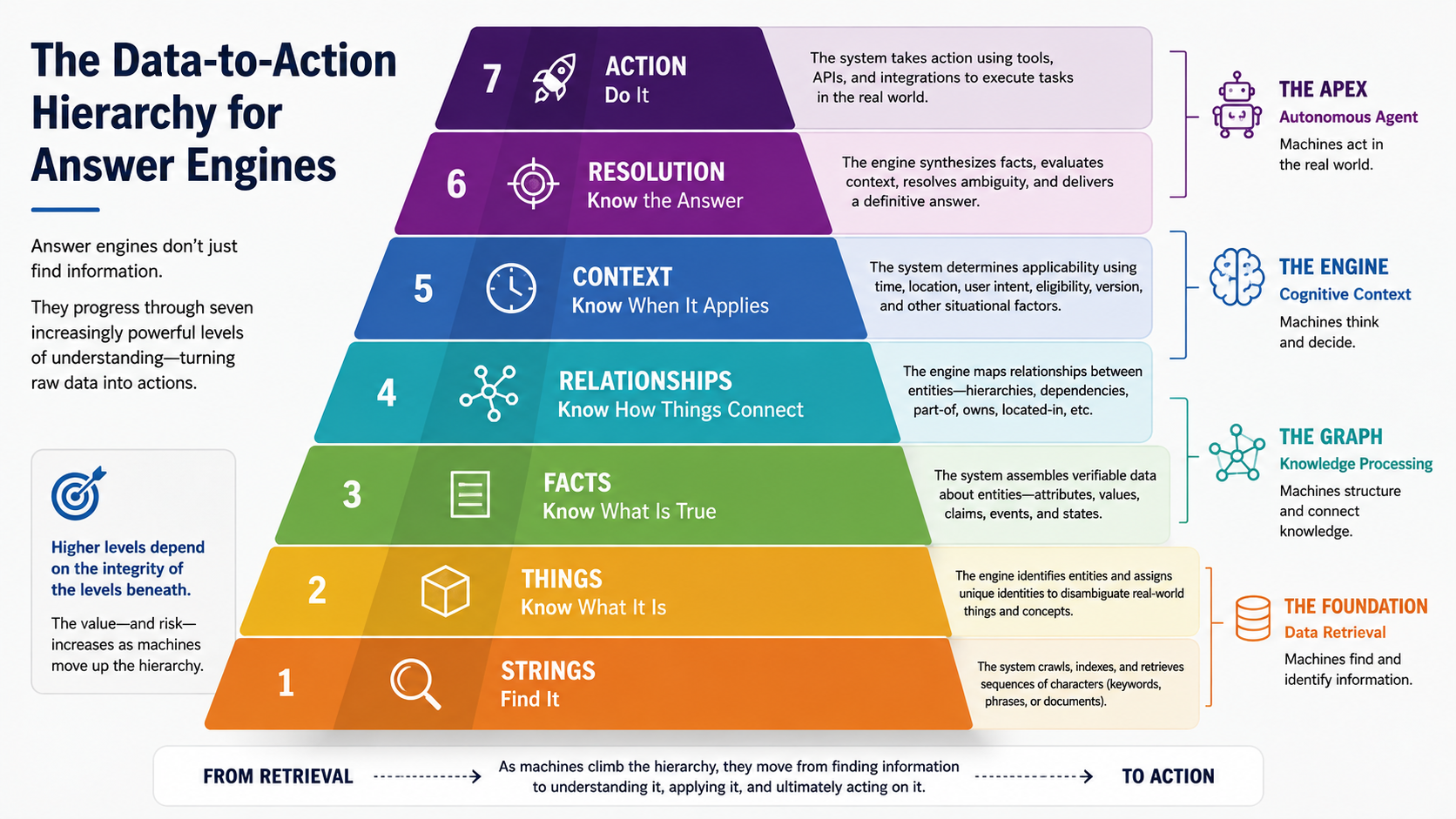
The model distinguishes seven increasingly consequential levels:
Strings → Things → Facts → Relationships → Context → Resolution → Action
The MedicarePlans.com experiment does not attempt to perform the upper levels of that hierarchy on behalf of an answer engine. Instead, it examines whether publishers can provide a stronger substrate for resolution by explicitly publishing the entities, facts, relationships, and contextual boundaries underlying human-facing content.
Mapping the Model to the MedicarePlans.com Experiment
| Hierarchy Level | MedicarePlans.com Example |
|---|---|
| Strings | Terms such as “Medicare Advantage,” “Mohave County,” plan names, and CMS identifiers. |
| Things | Mohave County, individual CMS plans, and the defined population of standard Medicare Advantage plans. |
| Facts | 16 standard Medicare Advantage plans; 11 PPO plans; 5 HMO plans; $31.37 average monthly premium. |
| Relationships | The 16 individual CMS Plan IDs identified in the associated index constitute the county-level aggregate. |
| Context | Plan year 2026; Mohave County, Arizona; standard Medicare Advantage plans only; Special Needs Plans excluded; source datasets and versions identified. |
| Resolution | The answer engine synthesizes the available facts, relationships, and context to resolve a user question. |
| Action | A person or autonomous agent may subsequently act on the resolved information. |
The publisher’s role in this experiment ends deliberately before resolution.
MedicarePlans.com publishes what it knows: identifiable entities, scoped facts, relationships, membership, temporal context, and source binding.
The answer engine remains responsible for synthesizing that knowledge into an answer. A person or autonomous agent remains responsible for deciding what to do with that answer.
This distinction is important because publishing contextual inputs is not the same as performing contextual reasoning. A publisher can state that a fact applies to plan year 2026, to Mohave County, and to standard Medicare Advantage plans excluding SNPs. The machine must still determine whether that information applies to the question it is attempting to resolve.
Viewed through the hierarchy, the field experiment therefore tests whether publishers can extend their machine-facing responsibility beyond retrieval and extraction into the publication of resolution-ready knowledge without attempting to perform resolution itself.
What the Study Is Observing
The Trust Publishing Institute is documenting publicly observable behavior associated with the deployment, including:
- crawling and indexing behavior;
- conventional search visibility;
- appearance within AI-generated search experiences;
- answer-engine source selection and citation;
- query-resolution behavior;
- changes in visibility over time;
- relationships between machine-published facts and generated answers; and
- differences between human-facing explanations and machine-facing knowledge representations.
Observations are recorded longitudinally where practical.
The study does not have access to proprietary search ranking systems, retrieval infrastructure, model weights, hidden inference traces, or internal answer-engine processes.
Accordingly, observations concerning public outputs are treated as observations rather than evidence of internal system behavior.
Initial Observations
Early deployment has coincided with changes in conventional search visibility and inclusion within AI-mediated answer surfaces for some MedicarePlans.com pages and queries.
Those observations are being preserved for longitudinal comparison.
At this stage, no causal relationship has been established between the machine-facing publishing architecture and observed changes in search or answer-engine visibility.
Numerous uncontrolled variables can influence those outcomes, including crawling and indexing cycles, algorithmic changes, query demand, competitive changes, source selection, and modifications elsewhere within retrieval systems.
The purpose of the field study is therefore not to demonstrate that a particular protocol “improves rankings” or “causes citations.”
The objective is to observe what occurs when an established web publisher begins explicitly publishing knowledge alongside content.
Why the Experiment Matters Beyond Medicare
Most information-rich organizations already possess structured knowledge.
A manufacturer knows its products, specifications, compatibility relationships, revisions, and recalls.
A university knows its programs, prerequisites, tuition, deadlines, faculty relationships, and accreditation.
A financial institution knows its products, rates, eligibility requirements, geographic availability, and effective dates.
A software company knows its products, versions, APIs, dependencies, compatibility rules, and deprecations.
Web publishing commonly transforms that knowledge into documents and pages designed for people.
Machine systems are subsequently expected to recover the underlying structure from those publications.
Dual publishing suggests another possibility:
Publish the explanation for people. Publish the knowledge for machines. Bind both to the same authoritative source.
If machine-mediated information retrieval continues to expand, the question may become less about how effectively machines can extract answers from pages and more about how effectively organizations publish what they know.
Relationship to Answer Engine Optimization
This experiment does not propose that Answer Engine Optimization is unnecessary.
AEO addresses a real and increasingly important problem: making published information understandable, extractable, attributable, and useful within machine-mediated information systems.
The field study examines whether AEO may nevertheless retain an architectural assumption inherited from traditional web publishing:
that the page remains the primary unit being optimized.
Dual publishing introduces another possibility.
The human-facing page remains a publication.
But the knowledge underlying that page becomes publishable as well.
If that distinction proves useful, machine-facing publishing may evolve from optimizing content for extraction toward engineering knowledge for resolution.
That remains a hypothesis under observation.
Study Limitations
No internal system access
The study observes public behavior only. It cannot determine how individual search or answer systems internally retrieve, rank, interpret, store, or reason over the experimental representations.
No causal attribution
Changes in search visibility, answer generation, citations, traffic, or other outcomes cannot be attributed solely to the machine-facing publishing layer.
Continuously changing environment
Search engines, answer engines, source corpora, models, algorithms, and competing publications change independently of the experiment.
Initial single-domain environment
MedicarePlans.com operates in an unusually structured, data-rich, regulated information domain. Results may not generalize to less structured publishing environments.
Architecture versus protocol
Observations concerning dual human-and-machine publishing do not establish that WebMEM is necessary, optimal, or uniquely effective for implementing such an architecture.
Publisher-controlled implementation
The experimental representations are produced by the publisher whose pages are being observed. Independent replication would be necessary to evaluate broader applicability.
Research Status
Active Field Observation
The deployment and its publicly observable outcomes will continue to be documented as the experiment develops.
August 2026 — Initial WebMEM v2 machine-facing knowledge deployment begins on selected MedicarePlans.com surfaces.
August 2026 — County-level Special Needs Plan aggregate and membership surfaces deployed.
September 2026 — Standard Medicare Advantage county aggregate and membership surfaces implemented.
September 2026 — County architecture normalized around paired DerivedStatsFragment and IndexFragment representations, separating aggregate knowledge from population membership and moving source attribution to associated Dataset representations.
Ongoing — Search, answer-engine, indexing, citation, and resolution behavior observed longitudinally.
Research Hypothesis
The experiment is organized around a proposition rather than a conclusion:
As machine systems become direct consumers of public information, organizations may need to publish what they know separately from how they explain it.
If that proposition proves useful, Answer Engine Optimization may represent one stage in a larger transition.
The web taught organizations to publish documents.
Search taught them to make those documents discoverable.
Answer engines may require organizations to make their knowledge resolvable.
Whether that becomes a distinct publishing discipline is the question this field study is intended to examine.